Before sending a copy of your ID to a letting agency, stamp it: rental file, Agence Martin, 11/07/2026. France ships an official tool for exactly that, filigrane.beta.gouv.fr. It works. It also uploads your document.
It uploads
The site says so, right above the button:
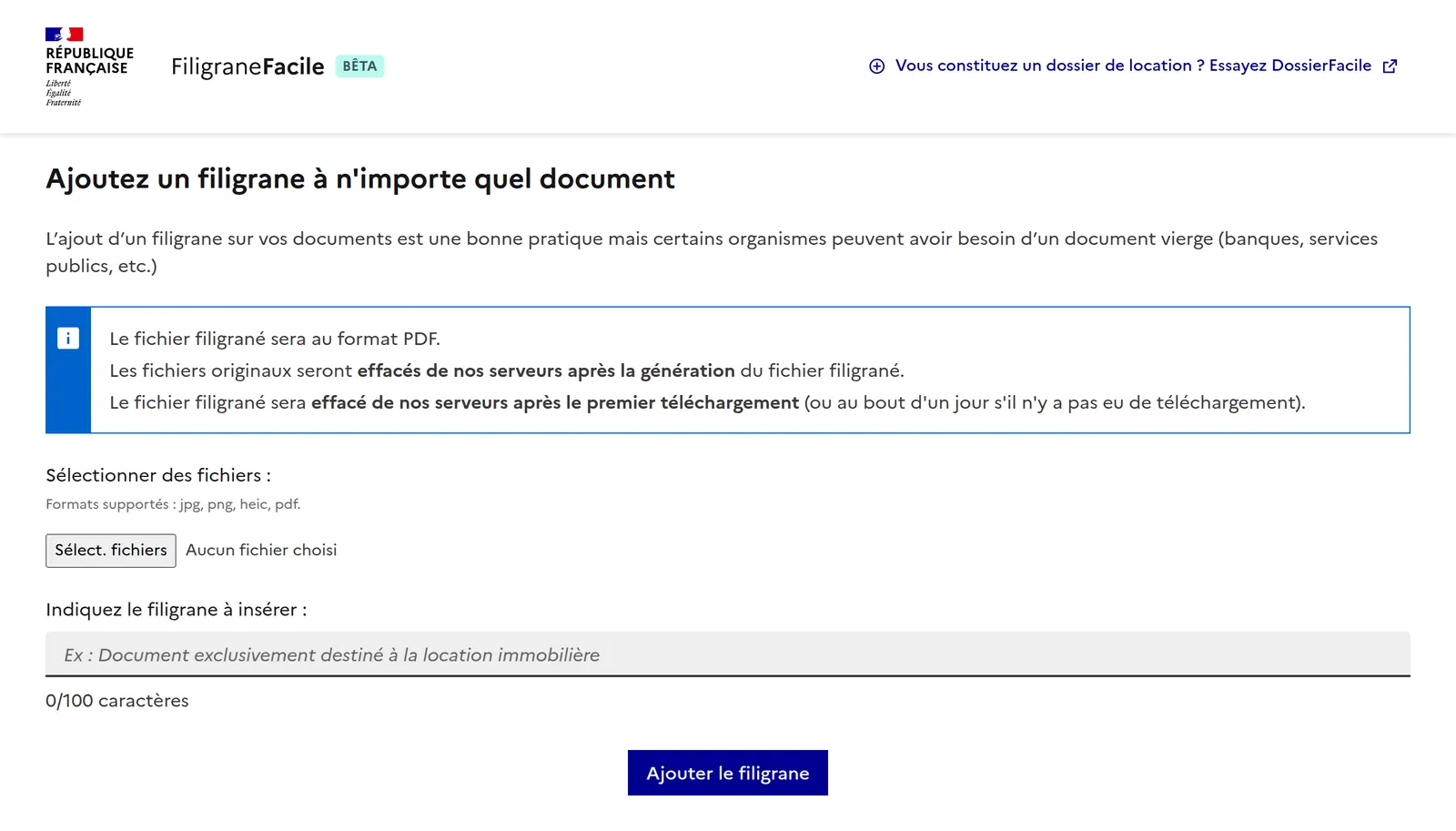
Les fichiers originaux seront effacés de nos serveurs après la génération du fichier filigrané.
“Deleted from our servers” implies they arrive there first. The network confirms it:
POST https://api.filigrane.beta.gouv.fr/api/document/filescontent-type: multipart/form-dataThe raw file, still unmarked, is processed server-side (Apache PDFBox on Scalingo) and returned by UUID.
The service is legitimate: SecNumCloud-certified, files deleted after download. But the order of operations is wrong. The document you were trying to protect sits on someone else’s machine before it gets the mark that protects it. From there, its safety is a policy, not a property.
The browser can do it
Render each page to a canvas, stamp the text, flatten it into the pixels, reassemble the PDF. None of that needs a server. So I rebuilt the tool that way: filigrane-local.fr (source).
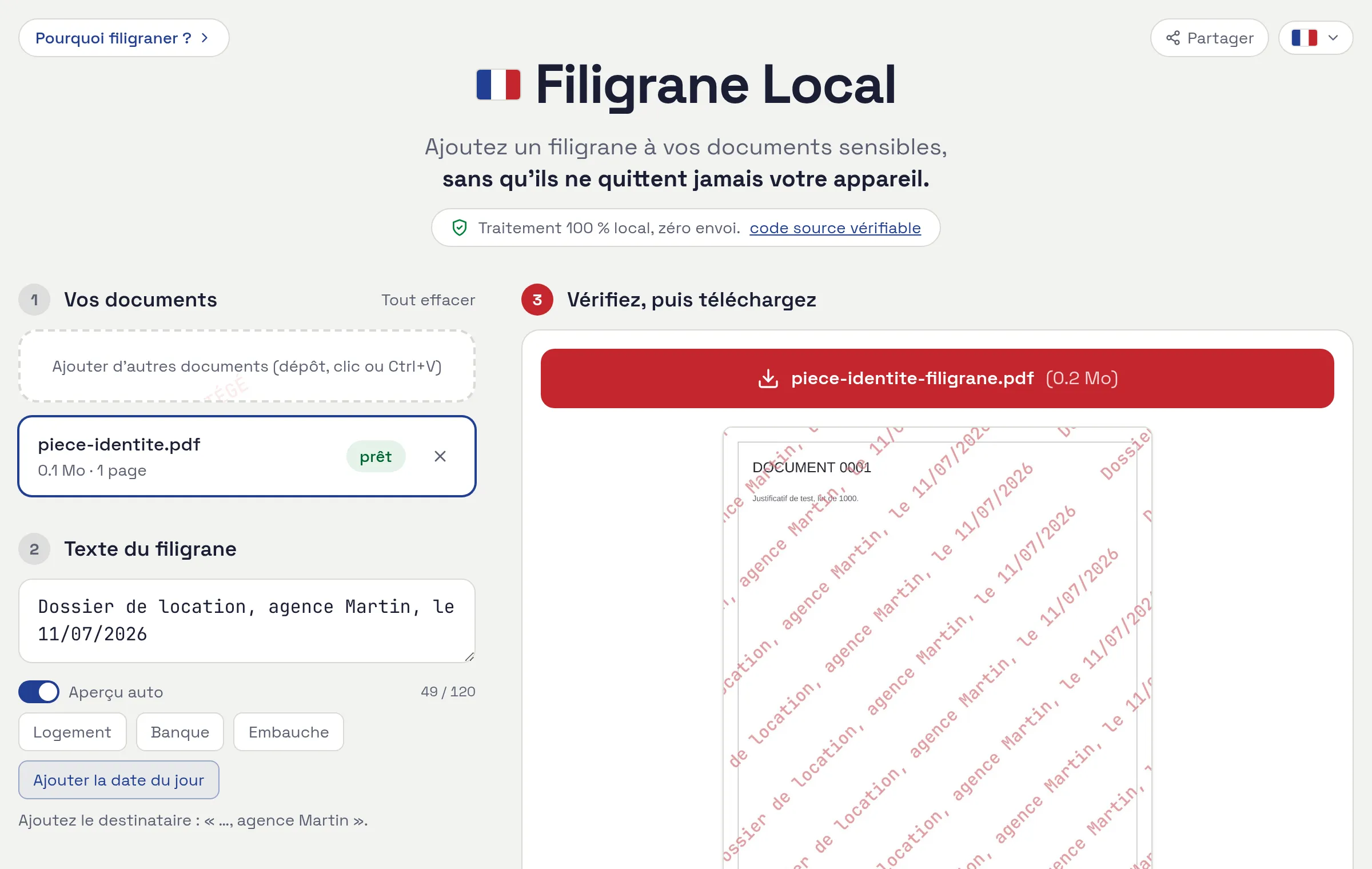
Same document, same result. The network tab during watermarking:
GET /pdfjs/pdf.worker.min.mjs (same origin)GET blob:... (in-memory preview)Nothing remote. A connect-src 'self' policy makes an upload impossible even if the code tried one, and the page keeps working offline.
You have no reason to trust my deployment either. It is a static export: bun run build, then serve out/ from wherever you like (source).
Watermark the copy before you send it. Just don’t send it to get it watermarked.
Avant d’envoyer une copie de votre pièce d’identité à une agence, apposez-y un filigrane : dossier de location, agence Martin, le 11/07/2026. L’État propose un outil officiel pour ça, filigrane.beta.gouv.fr. Il fonctionne. Il envoie aussi votre document.
Il l’envoie
Le site le dit, juste au-dessus du bouton :
Les fichiers originaux seront effacés de nos serveurs après la génération du fichier filigrané.
« Effacés de nos serveurs » suppose qu’ils y arrivent d’abord. Le réseau le confirme :
POST https://api.filigrane.beta.gouv.fr/api/document/filescontent-type: multipart/form-dataLe fichier brut, encore nu, est traité côté serveur (Apache PDFBox sur Scalingo) puis renvoyé par UUID.
Le service est légitime : certifié SecNumCloud, fichiers supprimés après téléchargement. Mais l’ordre des opérations est le mauvais. Le document que vous cherchiez à protéger se trouve sur la machine d’un tiers avant de recevoir la marque censée le protéger. À partir de là, sa sécurité n’est plus une propriété, c’est une politique.
Le navigateur sait le faire
Rendre chaque page sur un canvas, apposer le texte, l’aplatir dans les pixels, réassembler le PDF. Rien là-dedans ne réclame un serveur. J’ai donc reconstruit l’outil ainsi : filigrane-local.fr (code source).
Même document, même résultat. L’onglet réseau pendant le filigranage :
GET /pdfjs/pdf.worker.min.mjs (même origine)GET blob:... (aperçu en mémoire)Rien de distant. Une règle connect-src 'self' rend l’envoi impossible même si le code en tentait un, et la page continue de fonctionner hors ligne.
Vous n’avez pas plus de raison de faire confiance à mon déploiement. C’est un export statique : bun run build, puis servez out/ où vous voulez (source).
Filigranez la copie avant de l’envoyer. Évitez seulement de l’envoyer pour la faire filigraner.